
EXPLORE OUR WORK
Our centre engages in interdisciplinary research into innovation, technology and management throughout the developing world. This research informs public policymakers, private firms and individuals on some of the most important skills and capabilities in these areas which will help to lift nations out of poverty.
OUR PROGRAMMES
Technology and innovation play pivotal roles in the development of nations and lifting countries out of poverty. Our centre’s work in this area, spearheaded by Prof. Xiaolan Fu since 2008, has informed public policymakers, private firms and individuals on some of the most important innovation skills and capabilities in these areas which will help developing nations achieve inclusive prosperity.
This programme on the frontiers of industrial policy explores some of the blindspots of the literature that are highly relevant to the contemporary policy-making, seeking to push the knowledge frontier on how to design and implement green industrial policies that can help deliver greater social and economic equity across the globe, in a way that addresses the contemporary context of “polycrisis” while avoiding reproducing errors of the past.
For centuries, nature has represented a key source of inspiration for innovation. And while the climate agenda has taken an increasingly important space in the global policy arena, biodiversity constitute an equally imported-yet often overlooked- dimensions of global sustainability. Our biodiversity and innovation stream of research explores the opportunities, challenges, and policy tools for the development of nature-inspired innovation ecosystems.
OxValue.AI is a spin-out company from the University of Oxford’s TIDE centre. It provides an innovative way of utilizing data and AI technology to evaluate the monetary value of technology or technology-rich startup companies, which is a critical step towards supporting innovation and SMEs and facilitating technology transfer to developing countries.
This collaborative initiative between the Technology and Industrialization for Development Centre (TIDE) and FuturoLab aims to promote applied research and the international exchange of best practices in industrial policies aligned with the challenges and opportunities in the Mexican context and other Latin American countries.
A programme aimed at translating principles observed in biological systems into technologies that support the energy transition and wider sustainability goals, while ensuring fair benefit-sharing with communities in biodiverse regions.
PROJECTS
Technology Transfer, Innovation and Diffusion
-

Geopolitical competitions and the international political economy of low carbon technology transfer
What are the windows of opportunities for low carbon technology transfer for developing nations? What are we seeing more technology transfer in the context of an increasingly multipolar world? This research critically assess the state of climate and development cooperation, and examines the conceptual and practical dynamics that underpin a…
-

MNEmerge – A Framework Model on MNE’s Impact on Global Development Challenges in Emerging Markets
MNEmerge is a three-year (2014-2016) international research project that has received funding from the European Union’s Seventh Framework Programme for research, technological development and demonstration under Grant Agreement No. 612889. MNEmerge project explores the role of multinational enterprises (MNEs) in addressing global development challenges by mirroring the impacts of the…
-
Diffusion of Innovation in Low Income Countries (DILIC)
Technological innovation is a key element of industrialisation and catch-up in developing countries. Since innovation is costly, risky and path-dependent, groundbreaking innovation is highly concentrated in a few rich countries and amongst a small number of firms. Foreign sources of technology account for a large part of productivity growth in…
-
The Innovation and Catch-up in Platform Economy (ICPE)
The Innovation and Catch-up in Platform Economy (ICPE) project aims to examine the key factors that drive technological innovation and catch-up of world-leading technology companies from developing countries in the digital sector. It will also investigate how the ecosystems used by the digital platforms are developed through innovation strategies. There…
-
Innovation under the radar: The nature and sources of innovation in Africa
Investigating the nature, drivers and sources of innovation in Africa, this book examines the channels for effective diffusion of innovation in and to Africa under institutional, resource and affordability constraints. Fu draws on almost a decade of research on innovation in Africa to explore these issues and unpack the process,…
-

China Innovation & Entrepreneurship Programme
The China Innovation & Entrepreneurship Programme encompasses a wide range of research activities and projects since 2015. Those include:
-

Inclusive Digital Model (IDMODEL)
The Inclusive Digital Model (IDMODEL) project targeted young people and women, who are often marginalised and excluded from market participation due to unequal access to education, resources and information. Finding a way to help these groups develop income-generating activities is an important element in achieving the UN Sustainable Development Goals’…
-

Mobile Technologies and Health in India and China.
The Mobile Technologies and Health in India and China project, funded by Fell Fund and hosted by the Technology and Management Centre for Development (TMCD), brings together research and expertise from four departments and three divisions across the University. This project investigates the ways in which mobile phone utilisation can…
-

Rural E-Services in India
The Rural E-Services in India project is developing new, sustainable ways to deliver e-services and develop innovation capacity in poverty-stricken communities. By developing a system whereby farmers in rural India could resolve problems with crops using mobile camera phones, the project made it possible for them to discuss their challenges…
PROJECTS
Frontiers of Industrial Policy
-
The financing needs, constraints and mechanisms for regional industrialisation and energy integration in Latin America
Industrial development and transformations are long-term processes. They are thus highly dependent on the ability of countries to build institutional capacity capable of guaranteeing continuity at the institutional level, in the allocation of resources, or in the definition of priorities. For this reason, many historical experiences of rapid industrial development have taken place under authoritarian
-

Making industrial policy work in democratic contexts: balancing quick wins with long-term objectives and addressing the threats of populism
Industrial development and transformations are long-term processes. They are thus highly dependent on the ability of countries to build institutional capacity capable of guaranteeing continuity at the institutional level, in the allocation of resources, or in the definition of priorities. For this reason, many historical experiences of rapid industrial development have taken place under authoritarian
-

Multilateral dimensions of green industrial policy
Latin American countries have complementary strengths and assets, from abundant and complementary critical mineral wealth, to manufacturing capacity, proximity to important trade routes, and low-cost complementary renewable energy generation potential, which can all be leveraged to develop an efficient regional industrial ecosystem around low carbon technologies. To a large extent, the magnitude of improvements in
-

Survival of the Greenest
The pathways to economic development are changing. Environmental sustainability is no longer a choice but a necessity to maintain a competitive edge in the global economy. Just like in nature, where survival hinges on adaptation, this Element shows how nations adjust to -and take advantage of- the new dynamics of structural transformation induced by climate
-

The role of Civil Society in industrial policy-making: Continuity, balancing interests and watchdog mechanisms
Industrial policy is fundamentally transformative. It aims to alter productive structures that determine employment patterns, and the broader dynamism of an economy. It requires decision-making on what to produce, how, and for whom. As such, it is a truly collective (most often national) project with major economic, social and political consequences. Yet, it is too
-

Trade in Environmentally Sound Technologies: Implications for Developing Countries
With this project, TIDE centre (formerly TMCD), UN Environment and Norwegian University of Technology and Science (NTNU) aim to build global understanding on implications, capacity needs and enabling conditions for trade liberalization in environmentally sound technologies and thereby contribute towards sustainable, environmentally credible and inclusive value chain integration and trade in technologies, by providing support
PROJECTS
Biodiversity and Innovation
-

Nature’s Intelligence Ideathon
Overview The Nature’s Intelligence Ideathon is an international innovation challenge jointly organised by the University of Oxford’s Technology and Industrialisation for Development Centre (TIDE Centre) and the Development Bank of Latin America and the Caribbean (CAF). The Ideathon forms part of the launch activities of the Nature’s Intelligence Studio (NIS) at COP30 (Belém, November 2025).
-
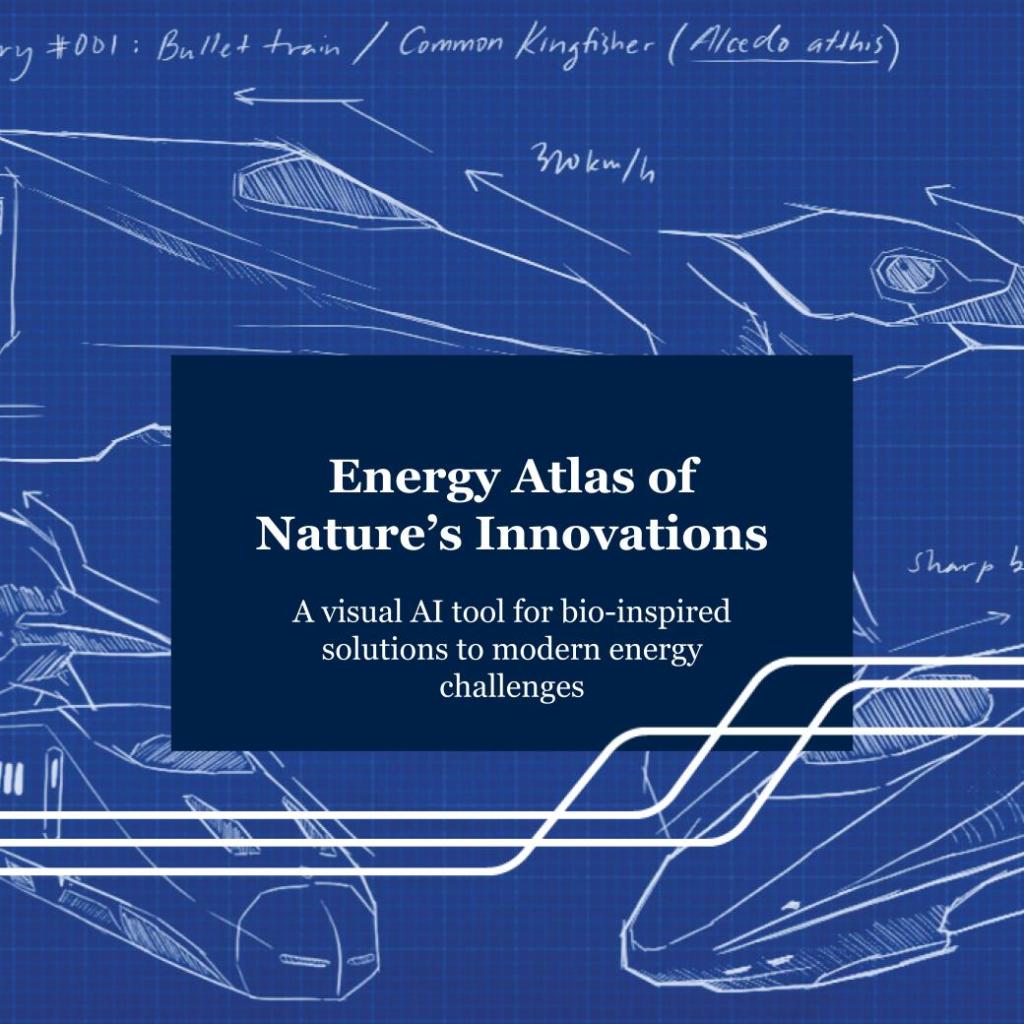
Energy Atlas of Nature’s Innovations
TIDE has partnered with Asteria to produce the The Energy Atlas of Nature’s Innovation, an AI tool that provides a glossary of the various methods nature has adopted to deal with the challenges posed by a rapidly evolving climate and massive transitions in the energy landscape. These methods serve as an inspiration for industries and
-
AI, biodiversity, and energy in Latin America and the Caribbean: from a resource-intensive to an ecosystemic tech
The paper explores the intersection of AI, biodiversity, and energy, emphasizing the need for a sustainable approach to tech developments. AI has the potential to boost economic growth, but its resource-intensive nature poses environmental risks, particularly due to energy and water consumption. We argue for a shift from a resource-intensive AI model to a symbiotic
-
Biodiversity-based innovation ecosystems in the Amazon region
The Amazon rainforest constitutes the world’s largest repository of biodiversity, a knowledge bank of solutions to both current and unknown challenges. This research explores the opportunities, challenges, and policy tools for the development of a biodiversity-based innovation ecosystem in the Amazon region. By explaining the ways in which the Amazon’s biodiversity be leveraged towards innovation
-
Nature-inspired innovation policy: Biomimicry as a pathway to leverage biodiversity for economic development
One of the most important challenges of the 21st century is the quest for economic development models that respect the planet’s ecosystem. Rather than imposing our industrial systems on nature, why not let nature influence our industrial and innovation systems? From wind turbine blades to bullet trains and solar cells, many of the technologies we
PROJECTS
Nature’s Intelligence Studio
-
Nature’s Intelligence Ideathon
Overview The Nature’s Intelligence Ideathon is an international innovation challenge jointly organised by the University of Oxford’s Technology and Industrialisation for Development Centre (TIDE Centre) and the Development Bank of Latin America and the Caribbean (CAF). The Ideathon forms part of the launch activities of the Nature’s Intelligence Studio (NIS) at COP30 (Belém, November 2025).
-
Energy Atlas of Nature’s Innovations
TIDE has partnered with Asteria to produce the The Energy Atlas of Nature’s Innovation, an AI tool that provides a glossary of the various methods nature has adopted to deal with the challenges posed by a rapidly evolving climate and massive transitions in the energy landscape. These methods serve as an inspiration for industries and
PROJECTS
Oxford – Mexico Industrial Policy Co-Lab
-
CALL FOR PAPERS: INDUSTRIAL POLICY IN MEXICO
Industrial Policy in Mexico: Governance Mechanisms and New Transformation Possibilities The Oxford México Industrial Policy Co Lab invites submissions for a new call for papers on industrial policy, innovation, and economic transformation in Mexico. The call focuses on how Mexico can respond to global changes such as trade fragmentation, climate transition, and technological change.
-
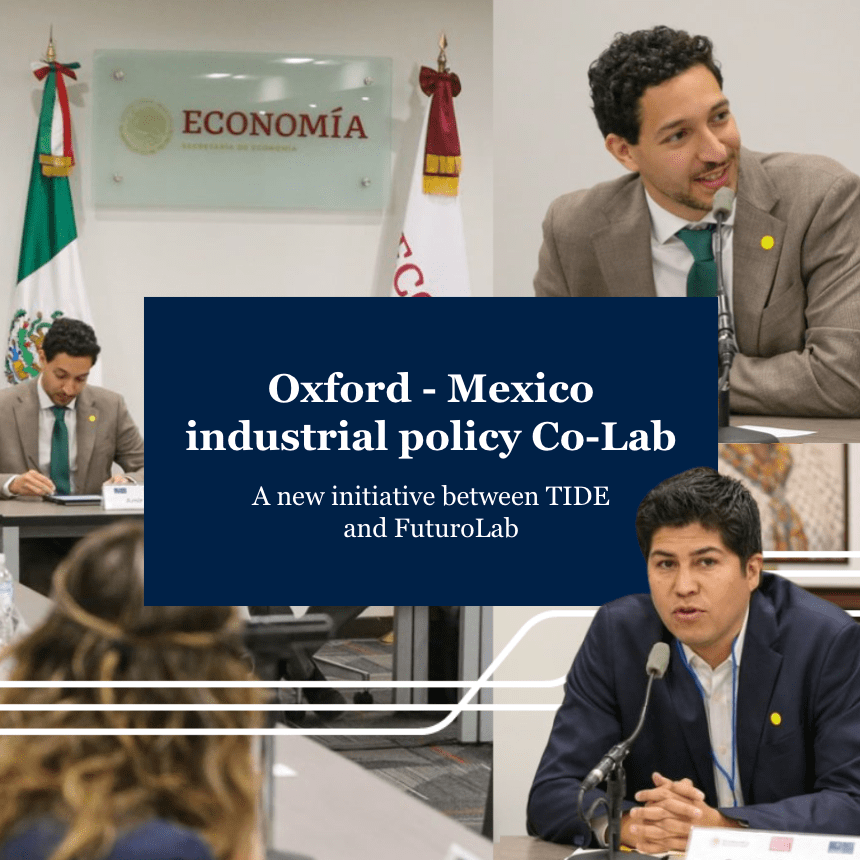
Oxford – Mexico industrial policy Co-Lab launch
We are excited to launch the Oxford-Mexico industrial policy Co-Lab! This collaborative initiative between the Technology and Industrialisation for Development Centre (TIDE) and FuturoLab aims to promote applied research and the international exchange of best practices in industrial policies aligned with the challenges and opportunities in the Mexican context and other Latin American countries. In
PROJECTS
Spin-outs
-
OxValue.AI
OxValue.AI is a spin-out company from the University of Oxford’s TIDE centre. It provides an innovative way of utilizing data and AI technology to evaluate the monetary value of technology or technology-rich startup companies, which is a critical step towards supporting innovation and SMEs and facilitating technology transfer to developing countries. OxValue.AI engages unique cutting-edge
Publications
-
WORKING PAPER 94 | Overlooked Industrialisation Opportunity? How Global South can Leverage Carbon Dioxide Removal (CDR)
Carbon dioxide removal (CDR) is a core component of achieving net-zero, and the only solution we have to address both residual and historical emissions. Since 2018, the sector has expanded rapidly, now exceeding 600 firms, growing by over 200% annually,… Read more
-
WORKING PAPER 93 | Regional Coordination of Green Industrial Policies: What can we learn from the ASEAN Experience?
The rise of national-driven green industrial policies, along with a new mercantilist era, marked by fragmented international cooperation and protectionism, threatens the inclusive pursuit of sustainable industrialization. Meanwhile, for many small nations, many of the ‘green windows of opportunities’ cannot… Read more
-
REPORT | Navigating the Currents of Green Hydrogen Towards a Human Development-Centred Framework
Navigating the Currents of Green Hydrogen Towards a Human Development-Centred Framework Green hydrogen, produced through renewable-powered electrolysis, is increasingly recognized as a key tool for decarbonizing hard-to-abate sectors such as heavy industry and long-distance transport. With abundant renewable potential, many… Read more
-
WORKING PAPER 92 | Critical Minerals & Resource Nationalism 2.0: Why the Policy is more Critical than the Mineral
Critical Minerals & Resource Nationalism 2.0: Why the Policy is more Critical than the Mineral “Critical minerals” are driving a new wave of resource nationalism around the globe. But to what extent is the current approach to critical minerals aligned… Read more
-
WORKING PAPER 91 | Can AI grow green? Evidence of an inverted-U curve between AI, energy use and emissions
Artificial intelligence (AI) promises to cut energy use, speed the shift to renewables and curb emissions, yet its early deployment typically raises national demand for power and CO₂ emissions. Analysing data for 23 middle- and high-income countries, we find AI… Read more
 TIDE Centre